Pearson Edexcel · GCSE · English Literature
Poetry Anthology: Time and Place (15 poems – Romantic, Literary Heritage, Contemporary)
The Edexcel 'Time and Place' anthology explores how the places we inhabit and the moments we experience shape our identities. It's highly rewarding to study because the 15 poems offer brilliant opportunities for comparative analysis, spanning two centuries of shifting attitudes towards nature, urbanisation, and belonging.
- 9 min read
- 2 worked examples
- 4 practice questions
- 8 key terms
Study Notes
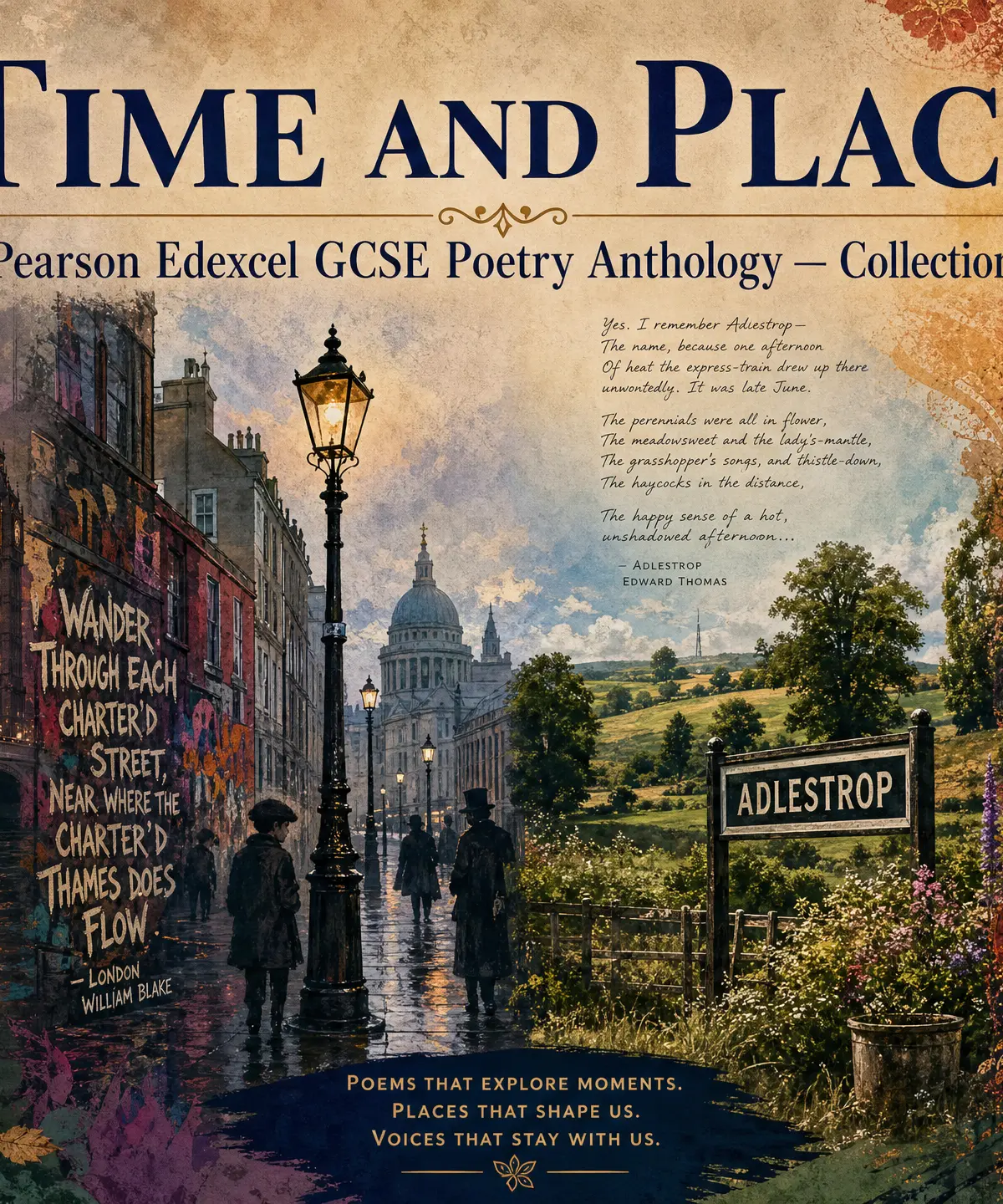
Overview
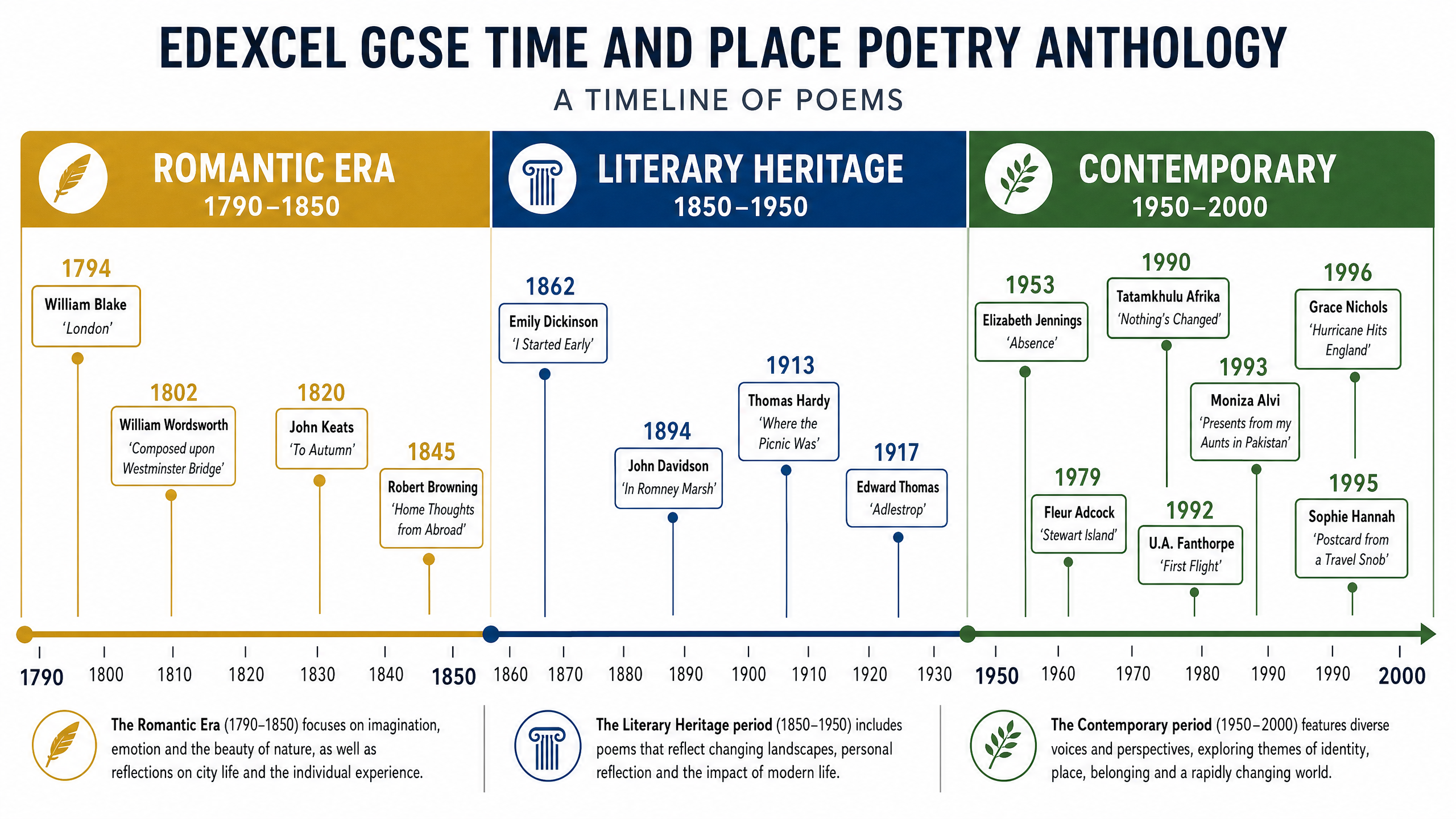
The Pearson Edexcel GCSE (9-1) English Literature Poetry Anthology: Time and Place (Collection C) consists of 15 prescribed poems. Examiners are looking for candidates to demonstrate a sophisticated understanding of how poets use language, form, and structure to explore the relationship between people and their environments. The collection spans three distinct literary periods: Romantic (e.g., Blake, Wordsworth, Keats), Literary Heritage (e.g., Browning, Hardy, Thomas, Dickinson, Davidson), and Contemporary (e.g., Alvi, Nichols, Afrika, Jennings, Adcock, Fanthorpe, Hannah). Strong responses will confidently compare how different poets present themes of memory, displacement, the power of nature, and the contrast between urban and rural settings, always integrating relevant contextual knowledge to illuminate meaning.
Podcast Episode
Listen to our 5-minute revision podcast covering core concepts, key poems, and exam technique:

The Poems
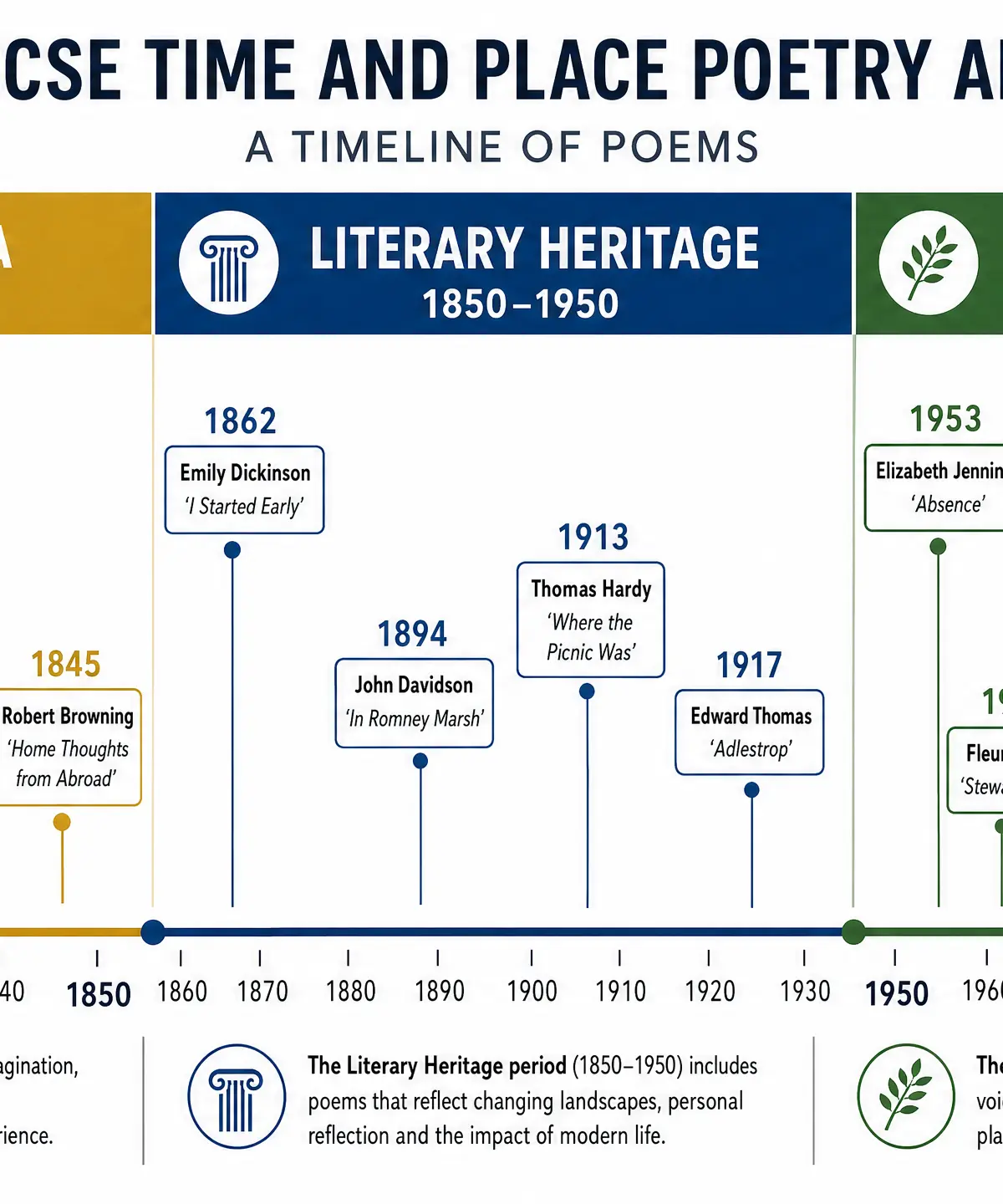
The Romantic Era (1790-1850)
**William Blake - 'London' (1794)**Blake presents a searing critique of the oppressive political and social structures of 18th-century London. He uses repetition ("marks of weakness, marks of woe") and powerful metaphors ("mind-forged manacles") to argue that the city's inhabitants are psychologically conditioned to accept their suffering. The rigid ABAB rhyme scheme mirrors the relentless control exerted by the Church and State.
**William Wordsworth - 'Composed upon Westminster Bridge' (1802)**In stark contrast to Blake, Wordsworth views London at dawn as a place of breathtaking, almost pastoral beauty. Using the Petrarchan sonnet form, he elevates the city to the status of nature, describing it as wearing the morning "like a garment." The poem captures a fleeting moment of perfection before the industrial reality of the day begins.
**John Keats - 'To Autumn' (1820)**Keats personifies autumn as a generous, almost maternal figure, creating a sensory masterpiece that celebrates the season's abundance. However, the poem is underscored by a gentle melancholy, acknowledging the transience of time and the inevitability of winter (and death).
The Literary Heritage Period (1850-1950)
**Robert Browning - 'Home Thoughts from Abroad' (1845)**Browning expresses a deep, nostalgic longing for an English spring from the perspective of an exile. The poem relies on precise, sensory natural imagery (the chaffinch, the elm tree) to convey how memory of place is often tied to specific details.
**Emily Dickinson - 'I Started Early – Took my Dog' (1862)**Dickinson presents a surreal, almost threatening encounter with the sea. The ocean is personified as a male figure that pursues the female speaker, exploring themes of the sublime power of nature, the unconscious, or even death.
**John Davidson - 'In Romney Marsh' (1894)**Davidson provides a vivid, painterly description of the Kent landscape at dusk. The poem celebrates the sensory experience of the marshland, contrasting the vastness of nature with the smallness of human infrastructure.
**Thomas Hardy - 'Where the Picnic Was' (1913)**Hardy returns to a place associated with past happiness and finds only the physical remnants (ashes, a charred stick). The poem is a poignant exploration of how places hold the memory of those who are no longer there, and the painful passage of time.
**Edward Thomas - 'Adlestrop' (1917)**Thomas captures a moment of unexpected stillness when a train halts at a rural station. The poem expands from a specific location to encompass the whole of the English countryside through the sound of birdsong. Written shortly before his death in WWI, it serves as a poignant farewell to an England that was about to change forever.
The Contemporary Period (1950-2000)
**Elizabeth Jennings - 'Absence' (1953)**Jennings explores the pain of returning to a place associated with a lost love. The fact that the physical environment remains unchanged only heightens the speaker's sense of internal devastation.
**Fleur Adcock - 'Stewart Island' (1979)**Adcock presents a blunt, unsentimental view of a New Zealand island. The poem challenges romanticised notions of nature, focusing instead on the harsh realities of the environment and the speaker's sense of alienation.
**Tatamkhulu Afrika - 'Nothing's Changed' (1990)**Afrika returns to District Six in Cape Town post-apartheid and finds that while the physical landscape has been altered, the deep-rooted social and racial inequalities remain. The poem is visceral and angry, written in the present tense to convey immediate physical reaction.
**U.A. Fanthorpe - 'First Flight' (1992)**Fanthorpe uses the experience of a first aeroplane journey to explore themes of perspective, vulnerability, and the relationship between humanity and the vastness of the sky.
**Moniza Alvi - 'Presents from my Aunts in Pakistan' (1993)**Alvi explores the complex experience of dual heritage. The speaker receives beautiful Pakistani clothes but feels she cannot inhabit them, describing herself as "half-English." The poem beautifully articulates the feeling of being caught between two cultures and the struggle for identity.
**Sophie Hannah - 'Postcard from a Travel Snob' (1995)**Hannah offers a witty, satirical take on modern tourism. The speaker's attempt to distance themselves from typical holidaymakers reveals a deep-seated cultural snobbery and an anxiety about social status.
**Grace Nichols - 'Hurricane Hits England' (1996)**Nichols describes a Caribbean hurricane striking the English landscape. For the speaker, the storm is a profound moment of connection, speaking to her in the language of Caribbean gods and bridging the gap between her two worlds, leading to a powerful sense of belonging.
Themes
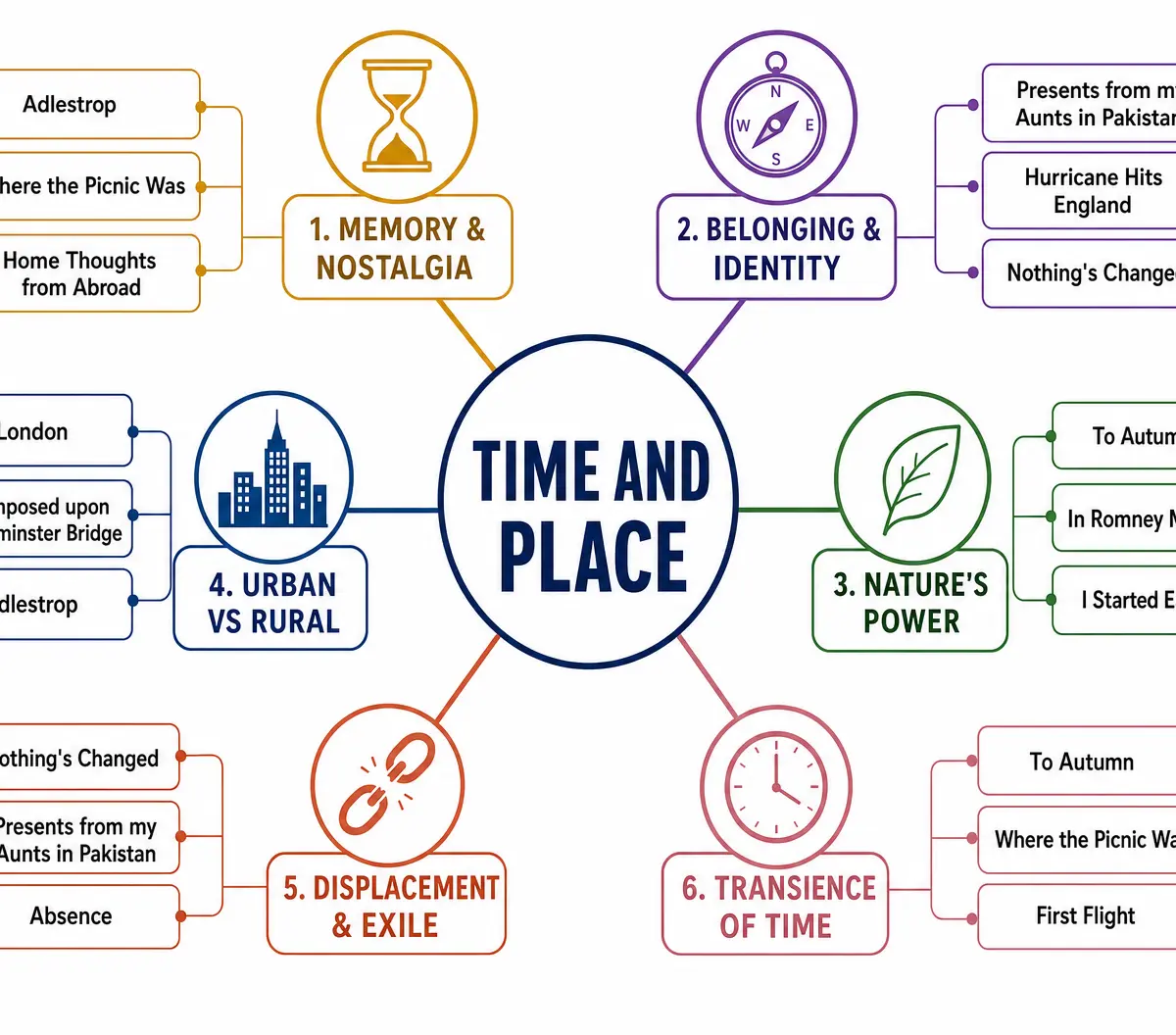
Theme 1: Memory and Nostalgia
Memory is a powerful force in this anthology, often tied to specific locations. Places become repositories for past experiences, and returning to them (or remembering them) evokes strong emotions.
Key Quotes:
- "Oh, to be in England / Now that April's there" ('Home Thoughts from Abroad') - Browning's exclamatory opening instantly establishes a tone of deep, immediate longing for a specific time and place.
- "Yes. I remember Adlestrop—" ('Adlestrop') - Thomas's conversational opening, followed by a caesura, mimics the act of a memory suddenly surfacing.
- "And the sea breathed on his charred stick" ('Where the Picnic Was') - Hardy uses the physical remnants of the fire as a metaphor for the fading of memory and life.
Theme 2: Displacement and Identity
Several contemporary poems explore the feeling of not belonging, either because of cultural duality, racial segregation, or the loss of a relationship.
Key Quotes:
- "I was half-English, / fractured / by my own reflection" ('Presents from my Aunts in Pakistan') - Alvi's use of enjambment and the word "fractured" physically breaks the line, mirroring the speaker's broken sense of identity.
- "No sign says it is: / but we know where we belong." ('Nothing's Changed') - Afrika highlights the insidious, unspoken nature of systemic racism; physical signs of apartheid are gone, but the psychological and social barriers remain.
- "Talk to me Huracan / Talk to me Oya / Talk to me Shango" ('Hurricane Hits England') - Nichols uses repetition and apostrophe to invoke Caribbean deities, showing how the storm reconnects her with her cultural roots.
Theme 3: The Power of Nature
Nature is presented variably as a destructive force, a source of profound beauty and solace, and a reflection of human emotion.
Key Quotes:
- "And made as He would eat me up -" ('I Started Early') - Dickinson's personification of the sea as a predatory male figure highlights the sublime, overwhelming power of the natural world.
- "Season of mists and mellow fruitfulness" ('To Autumn') - Keats's opening line uses soft 'm' and 's' sounds (sibilance) to create a tone of rich, peaceful abundance.
- "The wind is howling, catching its breath" ('Hurricane Hits England') - Nichols personifies the hurricane, giving it a voice and agency that commands the speaker's attention.
Theme 4: Urban vs. Rural
The anthology frequently contrasts the constructed, often oppressive environment of the city with the freedom and beauty of the natural world.
Key Quotes:
- "Near where the chartered Thames does flow" ('London') - Blake's repetition of "chartered" emphasises how human commerce and control have corrupted even the natural flow of the river.
- "This City now doth, like a garment, wear / The beauty of the morning" ('Composed upon Westminster Bridge') - Wordsworth uses a simile to suggest the city's beauty is temporary, a natural clothing that hides its usual industrial reality.
- "And all the birds of Oxfordshire and Gloucestershire." ('Adlestrop') - Thomas ends the poem with an expansive image, showing how the rural landscape transcends human boundaries.
Writer's Methods
Examiners (AO2) require you to analyse how meaning is created.
Form: Consider why Wordsworth chose a Petrarchan sonnet for 'Westminster Bridge' (traditionally used for love poetry, elevating the city) versus Blake's rigid, relentless quatrains in 'London' (mirroring the inescapable control of the state).
Structure: Look at enjambment. Alvi uses it heavily in 'Presents from my Aunts in Pakistan' to create a fragmented, hesitant rhythm that reflects her uncertain identity. Afrika uses short, blunt stanzas in 'Nothing's Changed' to convey barely suppressed anger.
Language: Analyse specific word choices. Why does Blake use "mind-forged"? Why does Nichols invoke specific gods like "Shango"? Move beyond feature-spotting (e.g., "this is a metaphor") to effect-analysing (e.g., "this metaphor suggests the psychological imprisonment of the poor").
Visual Resources
2 diagrams and illustrations
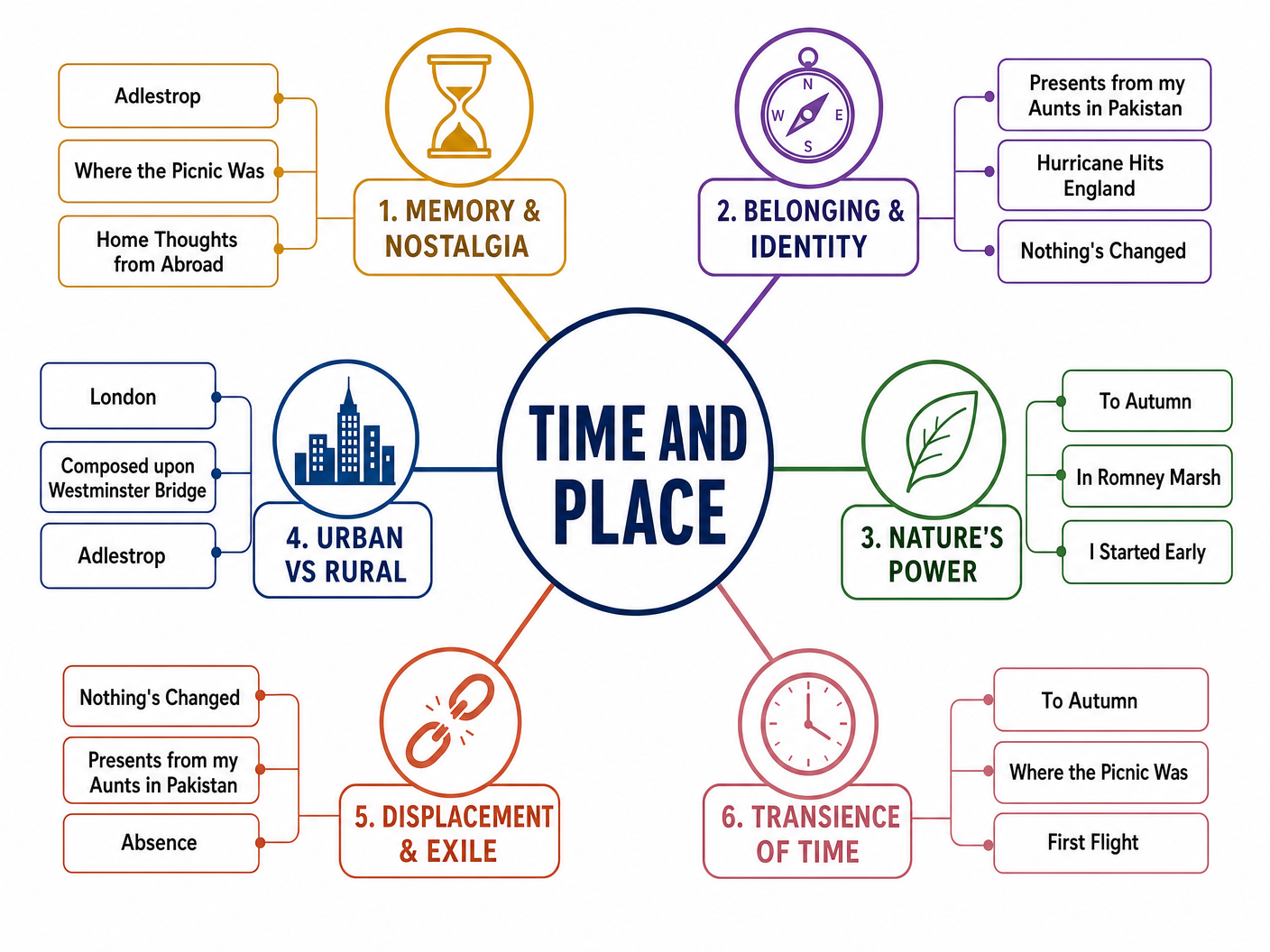
Interactive Diagrams
1 interactive diagram to visualise key concepts
Conceptual Flow Outline
The Process for Approaching the Poetry Comparison Essay
Worked Examples
2 worked examples — open one to explore the question and available guidance.
Practice Questions
Test your understanding — click to reveal model answers
Compare how poets present the experience of observing a specific place in 'Composed upon Westminster Bridge' and one other poem. (30 marks + 4 AO4)
Hint: Consider contrasting Wordsworth's awe with Blake's anger in 'London', or comparing it to Thomas's rural observation in 'Adlestrop'.
Compare how poets explore the passage of time in 'Where the Picnic Was' and one other poem. (30 marks + 4 AO4)
Hint: Compare Hardy's focus on memory and loss with Keats's focus on the changing seasons in 'To Autumn'.
Compare how the poets present the relationship between people and their environment in 'London' and one other poem. (30 marks + 4 AO4)
Hint: Compare Blake's oppressive urban environment with the racial oppression of the environment in Afrika's 'Nothing's Changed'.
Compare how poets present feelings of nostalgia in 'Home Thoughts from Abroad' and one other poem. (30 marks + 4 AO4)
Hint: Compare Browning's longing for a specific place with Thomas's unexpected memory of a place in 'Adlestrop'.